
Blog
How to Choose 358 Fence for High Security?
Choosing a 358 fence for high security begins with risk, not appearance. The FBI Crime Data Explorer’s 2023 national estimates recorded more than six million property-crime offenses. That figure does not prove every site needs maximum fencing. It does show why perimeter planning deserves careful attention.
A 358 fence uses narrow mesh openings, commonly 76.2 mm by 12.7 mm, with strong welded wire. The small aperture makes hand and foothold access difficult. It also limits the use of common cutting tools. Still, no fence is invincible. That matters.
The National Protective Security Authority (NPSA) recommends combining delay, detection, and response within a layered security plan. Therefore, fence height alone cannot define protection. A reliable specification should examine the site’s threat level, boundary length, lighting, CCTV coverage, gate controls, and emergency access. It should also consider soil conditions and vehicle approach routes.
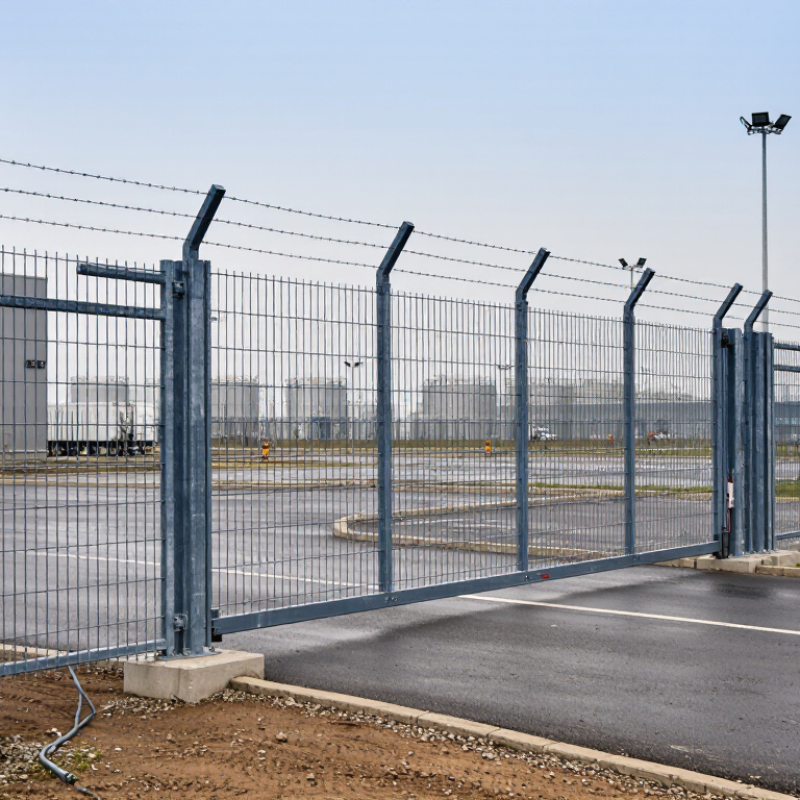
Look closely at the details. A 2.4-metre panel may perform poorly if its posts sit in weak ground. A secure mesh can also be undermined by a poorly designed sliding gate. Hot-dip galvanizing, suitable coatings, and sealed connection points help reduce corrosion. These choices matter near coastlines, chemical facilities, and wet industrial yards.
Industry guidance, including NPSA perimeter protection publications and ASIS physical asset protection practices, supports risk-based design rather than one universal product. Yet standards are not magic. Installation quality, inspection routines, and staff response can decide whether the barrier works as intended.
This guide explains how to compare 358 fence mesh, posts, foundations, gates, and anti-climb features. It also highlights compromises. The strongest option may not be the cheapest, fastest, or visually simplest.
Understanding the Security Design of 358 Fence
How to Choose 358 Fence for High Security?
Understanding the Security Design of 358 Fence
358 fence uses narrow mesh openings, usually about 76.2 by 12.7 millimetres. The pattern gives the fence its name: three inches by half an inch. These openings make climbing difficult because fingers and toes have little room to grip. They also limit the space available for cutting tools. Visibility matters. Security staff can inspect the boundary without facing a solid visual barrier.
The welded wire structure creates a rigid panel with limited flexibility. A typical 4-millimetre wire offers useful resistance, but no fence is impossible to breach. Its performance depends on post spacing, panel height, fixing clamps, and foundation quality. Weak connections can undermine a strong mesh. On site reviews, uneven ground often causes more trouble than expected. Careful surveying is essential.
Choose the height according to the site’s risk level, nearby structures, and access requirements. Avoid placing bins, trees, or equipment beside the fence, since they may become climbing aids. Gates need equal attention, including hinge protection, lock housing, and controlled closing. Lighting and cameras should cover blind areas without creating glare. Corrosion protection also matters in coastal or industrial environments. I sometimes see projects focus heavily on mesh strength and overlook drainage. That is a costly weakness. Regular inspections should check welds, posts, fasteners, coating damage, and ground movement.
How to Choose 358 Fence for High Security? - Understanding the Security Design of 358 Fence
| Design Dimension | Typical Specification or Option | Security Function | Selection Guidance |
|---|---|---|---|
| Mesh Opening | 76.2 mm × 12.7 mm (3 in × 0.5 in) | The narrow aperture makes it difficult to insert fingers, footholds, cutting tools, or other objects through the panel. | Choose the standard narrow aperture when climbing resistance and reduced tool access are key priorities. |
| Horizontal and Vertical Wires | Commonly arranged with 76.2 mm horizontal spacing and 12.7 mm vertical spacing | The dense wire arrangement limits hand and foot purchase while maintaining visibility through the fence. | Confirm the actual wire layout on technical drawings before approval, especially for customized panels. |
| Wire Diameter | Commonly 4.0 mm; heavier options may be available | A larger wire diameter increases rigidity and makes manual deformation and cutting more difficult. | Use a heavier wire specification for high-risk sites, but verify the additional weight against post and foundation capacity. |
| Panel Height | Often selected from approximately 1.8 m to 3.0 m or higher | Greater height increases the effort required to climb over the barrier and can improve perimeter separation. | Select height according to risk level, local planning rules, emergency access requirements, and site visibility. |
| Panel Width | Frequently about 2.0 m to 2.5 m per panel | A suitable panel width reduces the number of joints while keeping handling, transport, and installation practical. | Choose a width compatible with the site layout, lifting equipment, post spacing, and terrain conditions. |
| Panel Stiffness | Reinforced by dense mesh and correctly formed panel edges | Rigid panels are harder to bend away from the posts and provide a more stable barrier under physical pressure. | Inspect panel flatness, edge quality, weld consistency, and the proposed fixing arrangement. |
| Weld Quality | Continuous, uniform resistance-welded intersections | Secure welds help prevent wires from being separated and preserve the intended mesh geometry. | Request quality-control records or sample inspection results for weld strength and panel dimensions. |
| Post Profile | Commonly rectangular, square, or specialized hollow steel sections | Strong posts transfer loads from the panel to the foundation and reduce opportunities to force the fence sideways. | Match post size, wall thickness, spacing, and embedment depth to panel height, wind exposure, and soil conditions. |
| Anti-Tamper Fixings | Security bolts, shear-head nuts, or protected fixing systems | Tamper-resistant hardware makes it more difficult to remove panels with ordinary hand tools. | Use fixings that cannot be easily accessed from the public side and include secure nuts or protective covers where appropriate. |
| Surface Protection | Hot-dip galvanized steel, zinc-coated steel, or galvanized steel with a powder-coated finish | Corrosion protection preserves wire strength, weld integrity, and appearance throughout the service life. | Specify coating requirements according to humidity, pollution, salinity, and expected maintenance conditions. |
| Finish Color | Commonly dark green, black, or other project-approved colors | Color does not replace physical security, but a suitable finish can reduce visual distraction and blend with the surroundings. | Prioritize coating performance and repairability before selecting the color. |
| Visibility and Surveillance | High visual transparency through the narrow mesh | The open design supports camera observation, lighting coverage, and inspection of the perimeter without creating a solid visual screen. | Position cameras and lights to avoid blind spots created by corners, gates, landscaping, or nearby structures. |
| Climb Resistance | High when combined with narrow mesh, adequate height, and secure fixings | The small openings provide very limited footholds and handholds compared with conventional larger-mesh fencing. | For elevated risk, consider additional measures such as an outward overhang, monitored gates, lighting, and intrusion detection. |
| Cut Resistance | Improved compared with larger-aperture wire mesh; not completely cut-proof | The dense mesh makes it difficult to create a usable opening quickly, although determined attackers may still use powered tools. | Combine the fence with alarms, patrol procedures, controlled access, and suitable response arrangements. |
| Gate Integration | Matching mesh gates with reinforced frames and controlled locking hardware | A weak gate can undermine a strong perimeter because gates are common access and attack points. | Specify gate frames, hinges, locks, clearances, and automation as part of the complete security system. |
| Foundation and Ground Conditions | Concrete footings designed for local soil, wind, height, and loading conditions | A secure panel cannot perform properly if posts can be loosened, pulled out, or undermined. | Obtain a site-specific structural assessment for exposed, unstable, sloping, or heavily trafficked locations. |
| Inspection and Maintenance | Periodic checks of welds, fixings, coatings, posts, gates, and ground stability | Regular inspection helps identify corrosion, loose hardware, impact damage, and attempts to compromise the perimeter. | Establish an inspection schedule and repair damaged sections promptly to prevent security gaps. |
Note: Specifications shown are typical design references for 358 security fencing. Final dimensions, structural details, coatings, foundations, and installation methods should be verified against project conditions, applicable regulations, and a qualified engineering assessment.
Contact Us
Feel free to contact us anytime for questions, support, or assistance. We're here to help you with any inquiries you have.
- Address: 10220 S. Dolfield Rd Suite 110
Owings Mills, MD, 21117 - Email: sale@oshanbeauty.com
- Call Us: (410) 356-0000
- Working hours:
Monday – Friday: 9am – 5pm
Saturday and Sunday: Closed